Standards-Aligned Curriculum · 2026 Pilot Phase Catalog

K-12 Cybersecurity Courses

Structured, standards-aligned learning pathways — delivered through immersive, scenario-driven labs across every grade band.

3
Core Concepts
29
Course Topics
120+
Interactive Labs
4
Grade Bands
The NexGen Approach

Three Pillars. One Mission.

The NexGen Secure curriculum is built on three interlocking concepts — each one essential, each one reinforcing the others across every grade level.

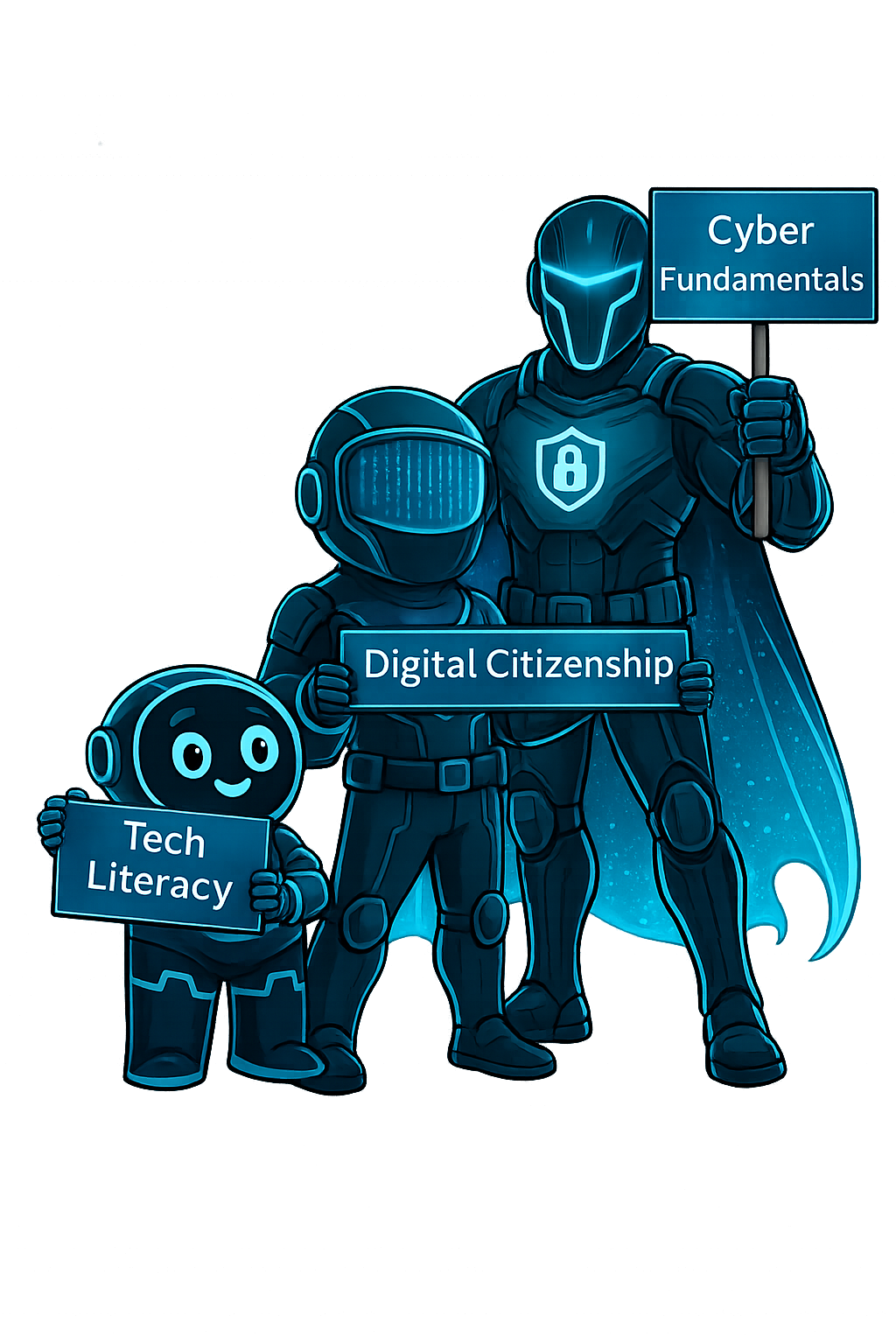
Three Pillars of NexGen Secure — Tech Literacy, Digital Citizenship, Cyber Fundamentals
Tech Literacy K–5

Before students can stay safe online, they need to understand what "online" means — how devices, networks, and the digital world actually work.

Digital Citizenship 6–8

How to navigate the digital world with safety, integrity, and responsibility — from protecting personal privacy to standing up against cyberbullying and online harm.

Cyber Fundamentals 9–12

Real-world security skills and the mindset of a defender — building the foundation for a future career in one of the most in-demand fields on the planet.

Three pillars. Fused together.
Securing the Next Generation.
See It In Action

Real learning for every grade level.

Age-appropriate experiences that grow with your students — from story-driven elementary modules to hands-on high school simulations.

K–5 Experience

Interactive learning
for younger students.

Story-driven modules, guided activities, and visual reinforcement introduce foundational digital safety and cybersecurity concepts in developmentally appropriate ways.

Elementary Course Preview
6–12 Applied Pathways

Hands-On Cyber &
Digital Safety Learning

Interactive, simulated environments allow students to analyze real-world scenarios — from phishing investigations to guided incident response and digital safety decision-making.

Career exploration, certification-aligned study prep, and resume guidance help students connect classroom learning to future opportunities.

High School Course Preview
Curriculum structured in alignment with the CYBER.ORG K-12 Cybersecurity Learning Standards — spanning 29 topics across 4 grade bands, delivered through 120+ interactive, scenario-driven labs.
Course Catalog

Explore by Grade Band

Topics are structured across four grade bands — with age-appropriate labs tailored to each level.

Showing 29 of 29 course topics
  Computing Systems
Network Communication
How devices communicate across networks — from understanding "online" to the OSI model and network topologies
K-2 3-5 6-8 9-12
6 labs
Career: Network Engineer
Network Components
Identifying and understanding routers, switches, access points, firewalls, and how network equipment connects us
K-2 3-5 6-8 9-12
4 labs
Career: Infrastructure Architect
Cloud Computing
Cloud storage fundamentals through IaaS, PaaS, and SaaS evaluation — shared responsibility and cloud-native security
K-2 3-5 6-8 9-12
5 labs
Career: Cloud Security Architect
Protocols
Internet services, communication protocols, ports, and how data travels securely across networks
K-2 3-5 6-8 9-12
5 labs
Career: Network Analyst
Data Loss
Data backup strategies, recovery methods, and disaster recovery planning to prevent and respond to data loss
K-2 3-5 6-8 9-12
4 labs
Career: Disaster Recovery Specialist
Network Hardware
Physical computing components, hardware vulnerabilities, and device risk mitigation strategies
K-2 3-5 6-8 9-12
4 labs
Career: Systems Administrator
Internet of Things
Smart devices, IoT ecosystems, connected device vulnerabilities, and IoT security analysis
K-2 3-5 6-8 9-12
4 labs
Career: IoT Security Specialist
Operating Systems
Understanding operating systems, comparing platforms, identifying end-of-life risks, and OS hardening techniques
K-2 3-5 6-8 9-12
4 labs
Career: Systems Engineer
Software Updates
Why updates matter, software vulnerabilities, bug hunting, and enterprise patch management strategies
K-2 3-5 6-8 9-12
4 labs
Career: Vulnerability Analyst
Programming & Scripting
From understanding how apps react to input, through coding fundamentals, to scripting for attack and defense
K-2 3-5 6-8 9-12
4 labs
Career: Security Developer
Applications
How applications are built, software vulnerabilities, security through software design, and cross-platform analysis
K-2 3-5 6-8 9-12
4 labs
Career: Application Security Engineer
  Digital Citizenship
Cyberbullying
Recognizing and responding to cyberbullying, upstander training, and building awareness campaigns
K-2 3-5 6-8 9-12
4 labs
Digital Footprint
Understanding digital traces, data harvesting, permanent online records, and managing your digital reputation
K-2 3-5 6-8 9-12
5 labs
Personally Identifiable Information
Protecting personal data, understanding PII trade-offs, data exposure analysis, and breach impact assessment
K-2 3-5 6-8 9-12
6 labs
Career: Privacy Analyst
Threat Actors
Understanding who attacks systems and why — from device decisions to threat actor motivation analysis
K-2 3-5 6-8 9-12
4 labs
Career: Threat Intelligence Analyst
Ethical Integrity
Spotting dangers, understanding white hat vs. black hat, cyber attack awareness, and ethics in cybersecurity
K-2 3-5 6-8 9-12
4 labs
Career: Ethical Hacker
Rules, Laws & Regulations
Online rules, internet laws, cyber law enforcement, and global jurisdiction and compliance frameworks
K-2 3-5 6-8 9-12
4 labs
Career: GRC Specialist
Intellectual Property
Understanding ownership, copyright, fair use, digital creation rights, and the innovation vs. protection debate
K-2 3-5 6-8 9-12
4 labs
Usage & User Agreements
Internet safety agreements, decoding digital terms, understanding the fine print, and organizational compliance
K-2 3-5 6-8 9-12
4 labs
Career: Compliance Analyst
  Security
CIA Triad
Confidentiality, Integrity, and Availability — the foundation of all information security decisions and design
K-2 3-5 6-8 9-12
4 labs
Career: Security Analyst
Access Control
Who gets to see what — from basic permissions to access control architecture, principles, and least privilege
K-2 3-5 6-8 9-12
4 labs
Career: Identity & Access Engineer
Data Security
Protecting data at rest, in transit, and in use — from basic concepts to enterprise security posture assessment
K-2 3-5 6-8 9-12
4 labs
Career: Data Security Analyst
Information Threats & Vulnerabilities
Spotting and understanding threats to information systems — from basic awareness to attack vector analysis
K-2 3-5 6-8 9-12
4 labs
Career: Vulnerability Analyst
Cryptography
Secret codes, Caesar ciphers, HTTPS vs HTTP, and modern encryption algorithms for securing communications
K-2 3-5 6-8 9-12
4 labs
Career: Cryptography Engineer
Authentication
Password security, identity verification, multi-factor authentication, and authentication security audits
K-2 3-5 6-8 9-12
4 labs
Career: Identity Engineer
Securing Network Components
Layered security strategies, building digital shields, network fortress design, and defense architecture evaluation
K-2 3-5 6-8 9-12
4 labs
Career: Network Security Engineer
Network Threats & Vulnerabilities
Network vulnerability discovery, social engineering simulation, and network attack analysis techniques
K-2 3-5 6-8 9-12
4 labs
Career: Penetration Tester
Physical Security Threats
Protecting physical spaces and equipment — from basic safety to comprehensive physical attack surface assessment
K-2 3-5 6-8 9-12
4 labs
Career: Physical Security Specialist
Security Controls
Trust verification, everyday security controls, and defense in depth — layered protection strategies
K-2 3-5 6-8 9-12
3 labs
Career: Security Operations Analyst

Join the 2026 Founding Pilot Cohort

Give your students access to standards-aligned, immersive learning experiences across every grade level.